
Review · BUKHARA
Best of Bukhara: All Day Private Old Town Tour
Bukhara’s Old Town reads like a textbook. This private day tour strings together the city’s biggest architectural hits, from the Ark of Bukhara fortress to the Kalon Minaret area, with enough stop time to actually notice details. You’ll also have room for photo moments and side streets that feel more local than tourist.
I especially liked two things. First, the private guide setup means you can go at a human pace, not the cattle-line kind of rhythm. Guides such as Gulnaz, Shakhnooza, Shaxnoza, and Bekhruza are repeatedly praised for clear English and city pride, and that makes the walking parts worth it. Second, the route clusters religious monuments, trade architecture, and old city squares so your brain connects the dots quickly.
One thing to plan around: museum and historical sites have an extra entrance cost (listed as $6.00 per person), and most of the stops do not include those entry fees. So it can feel like a better deal if you’re already happy to pay for site access, not if you want every door included.
In This Review
- Key points to know before you go
- Why this Old Town tour makes sense
- Lyab-i-Hauz pond square, Nasreddin, and the mosque complex feel like the city’s living room
- Po-i-Kalyan and the Great Minaret: the skyline moment you should not rush
- Registan area vibes and the Bolo Hauz Mosque stop: short, but it sets the Ark up
- The Ark of Bukhara: when fortifications and power make sense
- Trading domes and caravan-trade architecture: the commerce angle that most people miss
- Madrasas with tilework and tomb references: look for the small design cues
- Bukhara’s synagogue stop adds a different kind of context
- Where the best value shows up: the guide + the route, not just the stops
- Timing and pace: how to get the day you want
- Who should book this tour
- Should you book Best of Bukhara: All Day Private Old Town Tour?
- FAQ
- How long is the Best of Bukhara all day private old town tour?
- What does the tour cost?
- Is this tour private or shared?
- Is pickup included?
- Are entrance fees included for museums and historical sites?
- Is a mobile ticket provided?
- What else is included besides the guide?
Key points to know before you go
- Private guide, real pacing: You stay with your group all day, with time built into each key stop.
- Icon-to-icon route: Big sights sit close enough that you get momentum without marathon walking.
- Extra site fees to budget: $6.00 per person for museum and historical sites, since many entrances are not included.
- A mix of squares, mosques, and trade buildings: You see Bukhara as both a spiritual and commercial city.
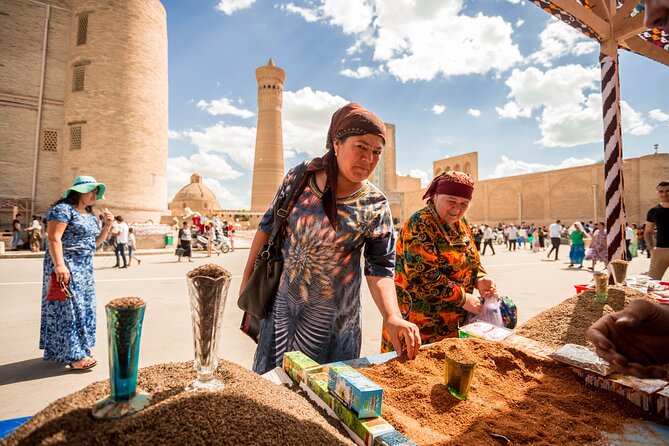
- Craft and market culture can fit in: Some guides have been known to add artisan workshops or market time by request.
- Pickup from central hotels: You meet the guide near where most visitors stay, then get moving.
Why this Old Town tour makes sense
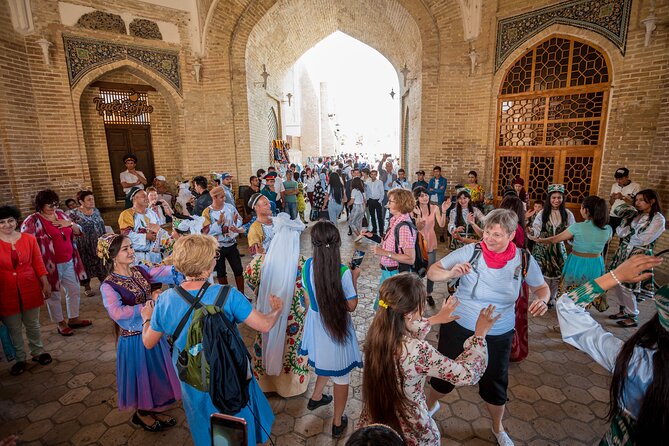
Bukhara’s Old Town is compact, and it’s built for pedestrian wandering. This tour takes that advantage and turns it into something practical: you walk a sensible loop where each stop explains the next one. Instead of seeing monuments like postcards, you connect them to how people lived, studied, and traded.
The private format matters here. In a place where multiple madrasas and mosques sit within a short radius, a good guide saves you from confusion. You figure out what you’re looking at, why it was important, and what changed over time. That is also why the guide names that come up often, like Gulnaz and Shaxnooza, matter. Their English and clear explanations are part of what makes the day click.
The “watch out” is the extra admissions. If you’re the type who hates surprises, you’ll want to mentally add the $6.00 per person for museum and historical sites, and accept that several stops are marked as not included.
Lyab-i-Hauz pond square, Nasreddin, and the mosque complex feel like the city’s living room
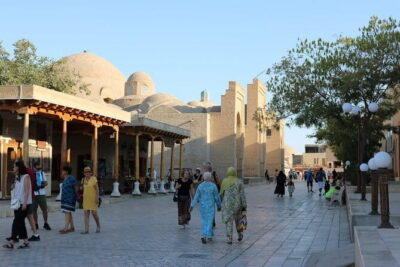
You start at Lyab-i-Hauz, a central square created in the 16th and 17th centuries, with the pond at its core. Translated as at the pond, it’s the kind of place where locals and visitors both pause, take photos, and watch life move. This is a smart first stop because the square gives you scale. Once you see the layout, the rest of the Old Town makes more sense.
In the same area, you also see the Monument to Hodja Nasreddin, a bronze figure installed in 1979. This stop is surprisingly useful, because it helps shift the day from stone and tiles into everyday culture. The statue sits beside the Lyab-i-Hauz complex, so you’re not bouncing across town to find it.
Then you’re set up to notice the religious architecture around the square, including Maghak-i Attori Mosque. It’s listed as part of the Lyab-i Hauz historical religious complex, and even with limited time, this is where you start building your “Bukhara spotting skills,” like recognizing how different buildings relate to one another around a shared public space.
Time here is short enough to keep energy up, but long enough to let the square breathe. If you’re sensitive to fatigue, this is also one of the easiest zones to pace yourself because you can stop for photos and just observe.
Deeper into the Bukhara old town
- Best of Bukhara: All Day Private Old Town Tour
★ 5.0 · 66 reviews - Best of Bukhara: All Day Private Old Town Tour
★ 4.9 · 62 reviews - City Tour Around Bukhara
★ 5.0 · 55 reviews - Bukhara Full Day Old City Private Tour
★ 5.0 · 46 reviews
Po-i-Kalyan and the Great Minaret: the skyline moment you should not rush
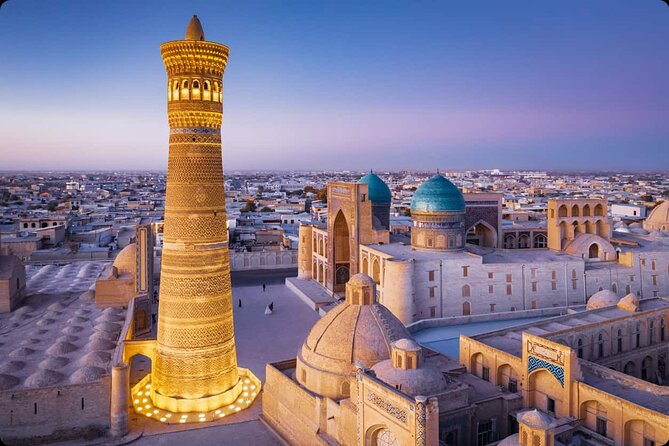
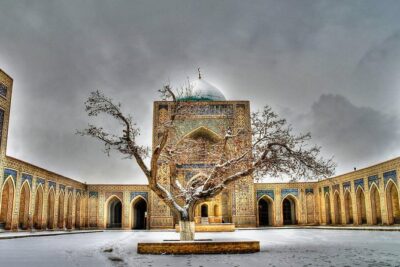
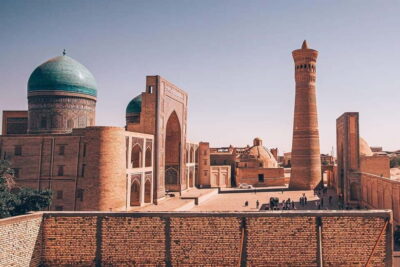
Next comes the Great Minaret of the Kalon, often described as one of Bukhara’s most prominent landmarks. Even without going inside for long, the minaret works as an anchor. Your guide’s job here is to help you understand what complex you are in and how the buildings share a single identity.
That complex is expanded at Poi Kalyan Mosque, listed as three parts: the Kalan Mosque, the Kalan Minaret, and the Mir-i-Arab Madrasah. This overlap is the reason a guided route is so valuable. Without context, you might treat them as separate sights. With context, you see a coordinated sacred center.
Right there you also cover Mir-i-Arab Madrasa, including a modern historical footnote: it was the only spiritual educational establishment in the USSR noted as beginning to function after WWII, and many leading imams from that era graduated from there. That kind of detail helps you read the buildings as active institutions, not just ruins.
Practical tip: this part of the day is mostly “look, then learn,” not “hands-on museum time.” So bring your attention. If you expect constant entry tickets, you might feel slightly annoyed later when you realize many sites in the day are not included.
Registan area vibes and the Bolo Hauz Mosque stop: short, but it sets the Ark up
From the Kalon zone, you shift to Bolo Hauz Mosque, built in 1712. It’s also described as opposite the Ark of Bukhara in the Registan district, and it is listed as part of a UNESCO World Heritage Site grouping along with other parts.
Even though the scheduled time is brief, this stop helps set up what you’re about to see next. The Ark is a massive fortress, and it helps to know that major sacred buildings are arranged across from it. It’s one of those urban design moves you don’t notice from afar.
If you’re thinking about photo timing, this is also a good mental reset. You’re moving from the tall, vertical emphasis of the Kalon complex to a strong sense of place and alignment across districts.
The Ark of Bukhara: when fortifications and power make sense
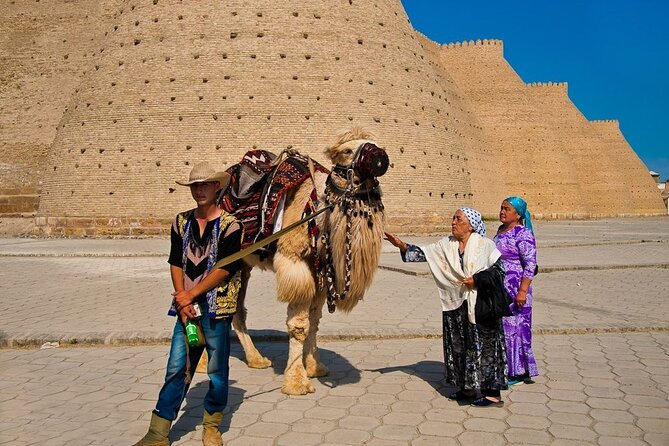
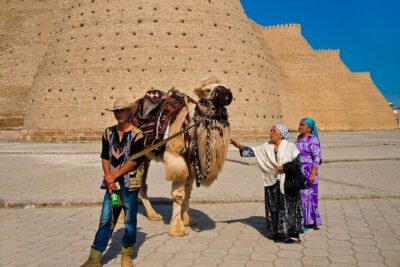
The highlight of the day, in terms of sheer scale, is the Ark of Bukhara, described as a massive fortress initially built and occupied around the 5th century AD. You get about an hour here, which is enough for a real look if your guide points out the story behind the walls.
Fortresses can feel like generic stone until someone connects them to political control, protection, and daily life. The Ark works well on a guided walking route because you’ve already visited religious education sites and public squares earlier. Now you’re seeing power infrastructure, the other side of the same city.
If you have mobility limits, this is a place where pacing matters. The tour is a walking itinerary with multiple monuments, and some guides have shown flexibility with walking speed for guests with medical constraints. You can ask for breaks, and if your guide understands, you can keep enjoying the day rather than rushing through it.
Trading domes and caravan-trade architecture: the commerce angle that most people miss
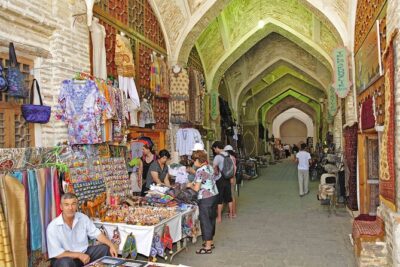
Most first-time visitors to Bukhara focus on mosques and minarets. This tour gives you the other half of the city through the Trading Domes and the Nodir Devon Begi Madrasasi.
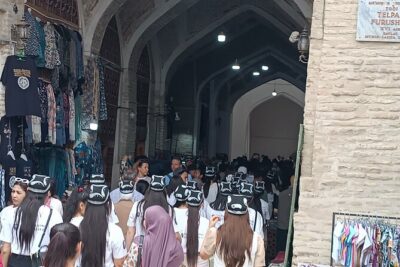
You visit the trading domes (only four remain in the ancient city) positioned along a north to south route through the old city. The tour also promises you’ll learn why they have their famous nickname, which is exactly the kind of detail that turns “pretty old buildings” into “I get what this place did.” Even if you only have 30 minutes, that context changes how you look at the structure and purpose.
Then you move to Nodir Devon Begi Madrasasi, built in 1622-1623 by the vizier of Imamkuli-khan. The key detail here is how it evolved: it was run as a caravanserai, later converted into a madrasah. That is not just trivia. It shows how the city’s needs shifted, and how buildings could be repurposed rather than abandoned.
This segment is where the walking route feels especially efficient. Instead of drifting from one landmark to the next, you’re following a trade corridor logic.
Prefer your own guide? More private Uzbekistan trips

Madrasas with tilework and tomb references: look for the small design cues
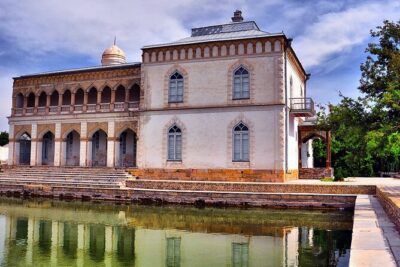
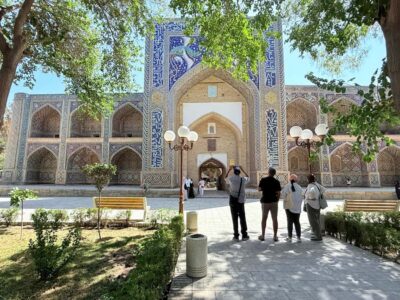
The later part of the tour leans into educational architecture. You’ll see Ulugbek Madrasah and Abdulaziz-Khan Madrasah, both listed as madrasas with historical timelines and notable features.
Ulugbek Madrasah is marked as completed in 1420, with exterior tiles, a fluted dome, stained windows, and old tombs. Even if you only spend around 30 minutes, this stop is perfect for training your eye. Tile patterns and dome shapes are a big part of how Bukhara communicates prestige and learning.
Abdulaziz-Khan Madrasah is given a connection to Ulughbek as a ruler and scholar who supported sciences, including his first madrasa built in 1417. The time is about 30 minutes, and the value is mostly interpretive. You’re not just photographing a facade, you’re understanding what kind of patronage built these centers.
A fair expectation: you may not get long interior stays at every site. If you’re hoping for hours inside museums, you might feel like you’re mostly doing exterior and guided viewpoints. On the other hand, if you want a fast, intelligent orientation across major institutions, this structure works.
Bukhara’s synagogue stop adds a different kind of context
The day also includes Bukhara Synagogue. It’s described as a holy place of worship in the Jewish religion, and it includes a striking note: before its construction, Jews of Bukhara prayed together with Muslims in the same mosque.
That one detail can change how you experience the broader religious landscape of the day. Instead of treating each building as a separate world, the guide helps you see how communities overlapped and how places of worship evolved.
The synagogue visit is scheduled for about 20 minutes. That means it’s not meant to replace a longer cultural deep dive, but it is meaningful as a short, respectful counterpoint to the Islamic monuments that dominate most Old Town itineraries.
Where the best value shows up: the guide + the route, not just the stops
At $65.00 per person for a private Old Town tour, value depends on your travel style. You’re paying for a guide-led route that hits major sites in a way that helps you connect them. If you’re the kind of traveler who reads signs, asks questions, and wants the story behind the buildings, the day tends to feel like a solid deal.
What you should budget for is the separate entrance fee: museum and historical sites listed as $6.00 per person. Many stops are explicitly not included, which means the experience cost can rise a bit once you add admissions.
Still, the included structure reduces the hassle. You get a private tour, a professional local guide, and photo opportunities, plus pickup arranged at central hotels. For solo travelers especially, that combination often beats piecing together taxis and self-guided routes, because you gain someone to explain what you’re seeing.
Timing and pace: how to get the day you want
The tour runs about 5 to 7 hours. In real life, the length depends on walking pace and how long you linger at each stop. Some guests report a half-day feel, while others describe a full set of stops without rushing.
My advice is simple: treat the schedule like a menu, not a checklist. If one stop grabs your attention, spend a little longer. If you’re tired, ask your guide to adjust and keep things moving. The best guides on this route are praised for doing exactly that.
Also, because you’re in a walking-heavy old district, start strong. Use the first square stop, Lyab-i-Hauz, to judge how the rest of the day will feel. If you’re good after that, you’ll likely enjoy the full circuit.
Who should book this tour
Book it if:
- You want a private walking orientation that connects Bukhara’s big icons.
- You care about why buildings exist, not only what they look like.
- You’re traveling with mixed ages, since guides have been praised for balancing a relaxed pace with solid explanations.
- You want someone to help with photo stops and on-the-ground context, not just directions.
Consider a different option if:
- You strongly prefer tours where most entrances are included in the base price.
- You want only a few of the top monuments and don’t want to walk to multiple madrasas, mosques, and trade sites.
Should you book Best of Bukhara: All Day Private Old Town Tour?
I think this is a good booking for the right mindset. If you’re excited by old architecture and want the city explained in plain language, the private guide format plus the tight route makes it a worthwhile day.
Just do two things before you go. First, budget the extra entrance cost for museum and historical sites ($6.00 per person) since it is not fully included. Second, pick a pace you can sustain, and know you can ask for breaks if you need them.
If you do those, you’ll end the day understanding why Bukhara looks the way it does, how learning and faith shaped the city, and how trade buildings helped it function.
FAQ
How long is the Best of Bukhara all day private old town tour?
It runs about 5 to 7 hours.
What does the tour cost?
The price is $65.00 per person.
Is this tour private or shared?
It’s private. Only your group participates.
Is pickup included?
Yes, pickup is offered, and the guide meets you at central hotels.
Are entrance fees included for museums and historical sites?
No. Entrance fee for museum and historical sites is listed as $6.00 per person.
Is a mobile ticket provided?
Yes, the tour includes a mobile ticket.
What else is included besides the guide?
The tour includes a private tour, a professional local guide, and photo opportunities.
More Tours Around Uzbekistan

The Full Uzbekistan Review Pile
Keep Walking Bukhara
More of Uzbekistan we have reviewed
- Full-Day Private Guided Tour to Islamic 7 Saints of Bukhara★ 4.5 · 3 reviews
- Uzbekistan 8 Days Private Guided Tour★ 4.6 · 3 reviews
- A Complete Chapter To Old Bukhara★ 5.0 · 5 reviews
- 2 – Days Guided Tour of Samarkand and Bukhara from Tashkent★ 5.0 · 5 reviews
- Bukhara Walking Tour★ 5.0 · 4 reviews
- A Group Walking Tour Of Old Town★ 5.0 · 8 reviews
Bukhara Old Town & Heritage Tours, compared.
 ★ 4.9Best of Bukhara: All Day Private Old Town TourFrom $6462 reviews
 ★ 5.0Bukhara Full Day Old City Private TourFrom $8546 reviews
 ★ 4.5Bukhara One Day Tour – Departure From TashkentFrom $24937 reviews
 ★ 5.0Private Guided Tours in Bukhara with Several OptionsFrom $5034 reviews
 ★ 4.9All You Need To Know About Bukhara. A Walk In The TownFrom $5531 reviews
 ★ 5.0One-Day Private Tour in the Old Town of BukharaFrom $6724 reviews
 ★ 4.4Bukharian Bath in Ancient Hammam with MassageFrom $6719 reviews
 ★ 3.9Bukhara Traditional Men’s Hammam / Bath XVI CenturyFrom $4911 reviews
Browse the lists this tour appears in