
Review · PRIVATE
Best of Khiva: Exclusive Private Tour!
Khiva feels like a living museum once you start walking. This exclusive private tour threads together UNESCO-listed Itchan Kala sights with a historian guide, ticketed monuments, and photo stops that keep your time efficient.
I really like two things here: the historian guide storytelling, and the fact the route hits the big-name monuments without you hunting for them. Guides such as Nilufer and Nargis are specifically praised for making the mosques, madrassas, and buildings feel understandable, not just decorative.
One consideration: you are walking for roughly 5 to 6 hours, and lunch is not included. There is also an optional extra fee if you want to climb the highest tower, listed at 15 USD.
In This Review
- Key highlights you will actually feel
- Walking Khiva’s Itchan Kala, one stop at a time
- Starting at Itchan Kala fortress walls
- Kunya-Ark: the old castle and the khan’s power center
- Two madrasas that explain religion and education
- Kalta Minor’s unfinished minaret: small building, big story
- Toshhovli Palace: a longer stop where you can take it in
- Pahlavan Mahmoud Mausoleum and the hero-healer legend
- Juma Mosque: central Ichan Kala and a steady payoff
- Gates at the end: Polvon Darvoza and Ota Darvoza
- Guides make the difference: Nilufer and Nargis style
- Price and value: what $76.80 per person buys you
- Walking time, comfort, and the optional tower fee
- Who should book this tour, and who might skip it
- Should you book this Best of Khiva private tour?
Key highlights you will actually feel
- Ticketed monuments inside Itchan Kala, so you spend time looking, not queueing
- Kunya-Ark and the khan-era sites early in the route for strong orientation
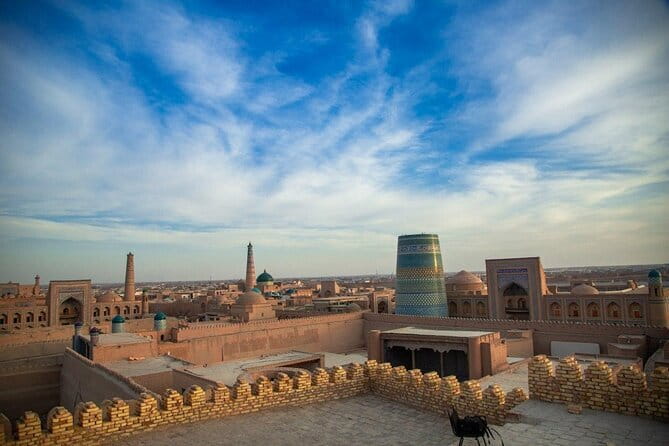
- Kalta Minor’s unfinished minaret and the story-focused approach to Islamic architecture
- A long list of major stops in one half-day, built for short stays
- Private pacing with pickup options, so you are not stuck in a slower group
Walking Khiva’s Itchan Kala, one stop at a time
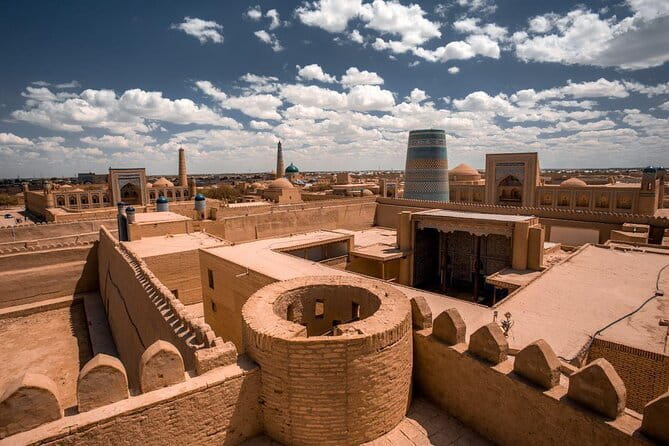
Khiva works best on foot. The old city is compact, but the streets and buildings are packed enough that a guide saves you from getting lost or missing the places that matter most. This tour is built for that, with a clear sequence of sights inside the walled UNESCO area.
Because it is private, you get a focused experience rather than a rushed line. Your guide can adjust the pace to your questions, and the route includes built-in photo stops where the best views are easier to frame.
The tour also respects your time. With a 5 to 6 hour format, it is a smart choice when you have other plans later, or you want to see a lot without turning the day into a marathon.
Starting at Itchan Kala fortress walls
Most Khiva days begin inside the walls, and this one starts at Itchan Kala. You get to explore the iconic fortress city and its historic streets right away, with an admission ticket included.
Why this first stop helps: getting your bearings early makes the rest of the walk click. When you begin with the fortress context, the later monuments like madrasas, mosques, and gates feel connected instead of random.
You also avoid the common mistake of spending too long just wandering. Here, the walking has structure, and that keeps the day rewarding even if you only have a short window.
More laps of the Ichan Kala walls
- Best of Khiva: Exclusive Private Tour!
★ 5.0 · 9 reviews - Best of Khiva: Exclusive Private Tour!
★ 5.0 · 3 reviews
Kunya-Ark: the old castle and the khan’s power center
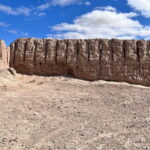
Next comes Citadel Kunya-Ark, also called the old castle. The tour describes it as built at the end of the 17th century, dated 1686 to 1688, by Anushakhan’s son Arangakhan. It also gives you the scale: the fortress is listed as 130 by 93 meters.
What I like about placing this stop early is that it gives you a political anchor. You see the setting for official life and authority, including mention of a hall for official reception. Even if you are not a deep architecture person, this kind of orientation helps you read the rest of the city with more meaning.
A small drawback to plan for: this is a lot of information in a short span. If you prefer less explanation and more free wandering, you may want to ask for the highlights, not the full lecture.
Two madrasas that explain religion and education
Khiva’s Islamic architecture is often about more than pretty shapes. This tour pairs madrasas in a way that helps you understand why education and faith were intertwined in these spaces.
First is Mohammed Rakhim Khan Madrassah. The tour notes it is located east of Kunya-Ark, which is useful because it keeps you oriented. It also shares the ruler’s full name, Said Muhammad Rahim Bahadur Khan, and that locals called him Madraim Khan II.
Then later you move to Mohammed Amin Khan Madrassah. This one is described as a distinguished landmark within Ichan Kala. If you like tile work and architectural details, this stop is a great time to slow down, because the guide’s explanations are meant to connect decoration to story.
A practical tip: madrassas and mosques can feel similar at a glance if you are just staring upward. Ask your guide what to look for before you start walking around the corners, so you know what detail matters most.
Kalta Minor’s unfinished minaret: small building, big story
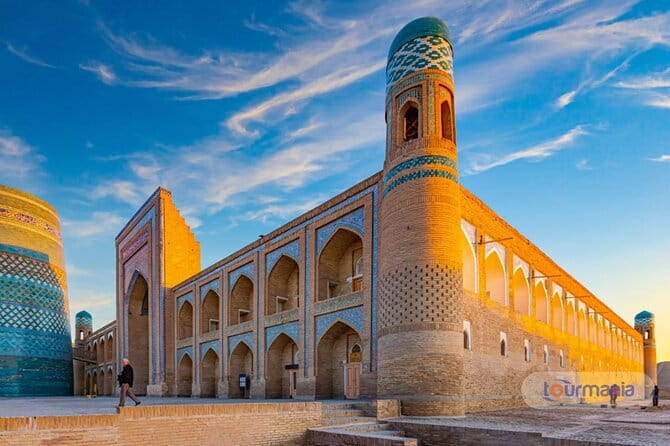
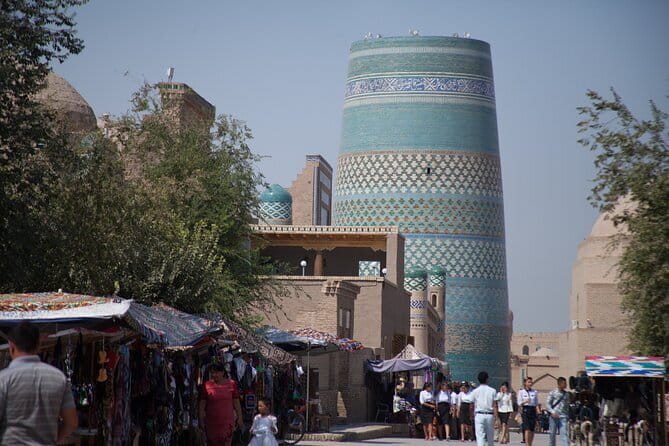
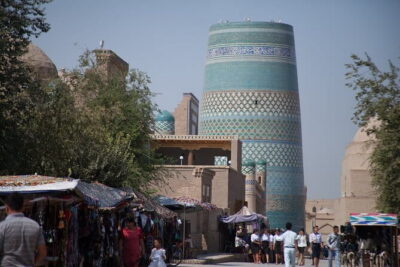
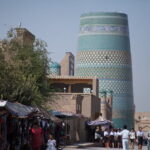
One of the most memorable stops on this route is Kalta Minor Minaret. The tour explains its meaning, Low tower, and notes it was erected in the 19th century by ruler Mukhammad Amin-khan. The key detail is also the point: it is unique because it was not completed.
That unfinished element changes how you experience the structure. Instead of treating it as a finished monument, you look at it as a moment in time. This is the kind of detail that a good guide can turn from trivia into understanding.
If you are the type who likes architecture that has a human reason behind it, this stop will land well. If you want only finished, fully complete sites, you might find it emotionally strange, but that is exactly what makes it interesting.
Toshhovli Palace: a longer stop where you can take it in
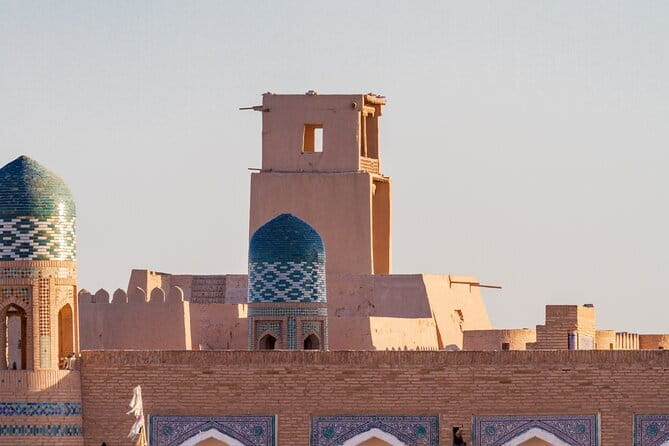
After the minaret, the route heads to Toshhovli Palace for about an hour. The tour describes it as a prominent historical complex within the ancient walled city of Khiva.
This is your breath point in the schedule. It is long enough to wander a bit, look at different angles, and let the explanations sink in. If your legs are already talking, this is a good moment to pace yourself and take photos without rushing.
One drawback: a palace stop can feel like a lot if you are tired from earlier walking. If that happens, ask the guide for the one or two main things to focus on here, then enjoy the rest at your own pace.
Prefer your own guide? More private Uzbekistan trips
Pahlavan Mahmoud Mausoleum and the hero-healer legend
Another standout in the itinerary is the Pahlavan Mahmoud Mausoleum complex. The description places it not far from Juma Mosque and identifies Pahlavan Mahmud as a local poet and philosopher.
What makes this stop more than a name plate is the story detail: he was famous for heroic strength and the ability to heal people. In a city full of monuments, this kind of legend gives the buildings a human center.
If you like meaning behind places, you will probably enjoy this portion. If you mostly want architecture, you can still use it as a context anchor, since the mausoleum is part of the same central spiritual landscape.
Juma Mosque: central Ichan Kala and a steady payoff
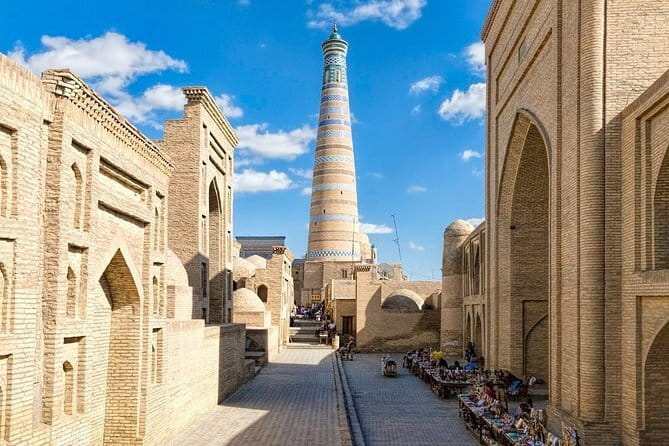
The tour then moves to Juma Mosque, located in the central part of Ichan Kala. It is described as near other prominent structures as well, which reinforces the idea that this area is a hub.
A mosque stop works best with a guide because the significance comes from more than what it looks like. Here, the included 40 minutes gives enough time to appreciate the setting and learn what the city is trying to communicate through these structures.
If you are photographing, save a few minutes to step back from the closest view. In Khiva, the best photos often come after you see how the surrounding buildings shape the space.
Gates at the end: Polvon Darvoza and Ota Darvoza
The route finishes with two classic gateways: Polvon Darvoza Gates and Ota Darvoza.
For Polvon Darvoza, the tour frames it as a historic city gate built centuries ago that once controlled access and welcomed merchants. That merchant idea pairs nicely with what you learned earlier about trade and city life.
Then comes Ota Darvoza, described as one of the main gates of Khiva’s walled old city. The tour highlights its role as a key entrance for traders and travelers along the Silk Road.
These gate stops are excellent for two reasons. First, they help you understand the city as a system, not just a collection of buildings. Second, they give you a natural stopping point. By the time you reach the gates, the walking route feels complete.
Guides make the difference: Nilufer and Nargis style
This tour’s biggest strength shows up in the guide feedback. Nilufer is praised for excellent explanations and stories, and for the way a walking guide ensures you see everything. Nargis is praised for bringing the mosques, madrassas, and museums to life, with explanations that make the sites feel less like items on a list.
Why this matters for your experience: Khiva can overwhelm you if you are flying solo. Tiles, arches, doorways, and minarets all start to look similar after a while. A strong guide turns the overwhelm into focus.
So if your goal is understanding, not just photos, this tour is a good match.
Price and value: what $76.80 per person buys you
The price is $76.80 per person, and it is priced for a half-day that does a lot in one go. What makes it feel like value is the bundle.
You get a guide historian, entrance tickets for the monuments, and all fees and taxes. You also get private transportation transfer if you choose the pickup with transportation option, plus pickup offered and photo stops at the best spots. There is also a mobile ticket, which makes the day easier once you are on the ground.
Here is the practical math mindset to use: if you add up the cost of a guide plus individual entrance tickets, you often end up close to or higher than the tour price, especially in a place where you only have a few hours.
The tour is also private, and that matters. In a crowded UNESCO area, a small efficiency edge becomes big, because every wasted minute is time you cannot get back.
Walking time, comfort, and the optional tower fee
This is a walking tour, about 5 to 6 hours. That does not mean it is brutal, but it does mean you should dress for long time on your feet. If you plan to do the stops thoughtfully, you will appreciate comfortable shoes and a steady rhythm.
There is one extra cost to know about: climbing the highest Tower has an additional fee listed at 15 USD. The itinerary you see here does not guarantee that climb is mandatory, so if you are sensitive to extra expenses, you can plan around it. If you do want the tower viewpoint, budget for it.
Also note: lunch is not included. If you need a full meal, plan to eat before or after. If you snack on the go, bring something small so you do not feel rushed when hunger hits.
Who should book this tour, and who might skip it
I think this tour is best for three kinds of travelers.
First, if you have limited time in Khiva. The route is designed to cover a lot of the major sites inside Ichan Kala in one structured sweep.
Second, if you want meaning. The guide-led approach, with names like Nilufer and Nargis associated with strong storytelling, is ideal if you like explanations that connect architecture to people and purpose.
Third, if you prefer convenience. Tickets are included, and you get pickup and a private pace. For many people, that is the difference between a good day and a smooth one.
You might skip it if you want to roam with zero structure, or if you are the type who already knows exactly which sites you want and prefers to set your own route. Also, if you do not want to spend 5 to 6 hours walking, you may want a shorter, lighter option.
Should you book this Best of Khiva private tour?
Book it if you want a guided, ticketed, half-day plan that hits the UNESCO old town monuments without turning your day into logistics. The route makes sense: start at Itchan Kala, orient with Kunya-Ark, then move through major madrasas, the memorable Kalta Minor, the palace complex, the mausoleum story stop, and end with the gates that frame trade and travel.
Skip it if your top priority is freedom to wander without a schedule, or if a long walking block does not fit your stamina. If that optional highest tower fee would stress your budget, you can plan around it.
If you want a day in Khiva that feels organized and understandable, this private walk is a strong choice.
More Tours Around Uzbekistan
The Full Uzbekistan Review Pile
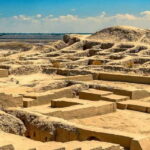
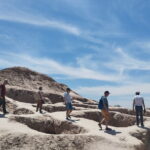
Still Inside Khiva? Keep Going
More of Uzbekistan we have reviewed
- Best of Khiva: Exclusive Private Tour!★ 5.0 · 3 reviews
- Traditional Khiva Cooking Class with Market Visit & Lunch★ 5.0 · 4 reviews
- Ayaz Kala & Toprak Kala private fortress daytrip from Khiva★ 3.5 · 6 reviews
- Private Daytrip to Muynak and Nukus★ 5.0 · 10 reviews
- Best of Khiva: Exclusive Private Tour!★ 5.0 · 9 reviews
- Private Transfer & Photo‑Stops: Ayaz‑Kala & Toprak‑Kala”★ 4.6 · 6 reviews
Private, compared.
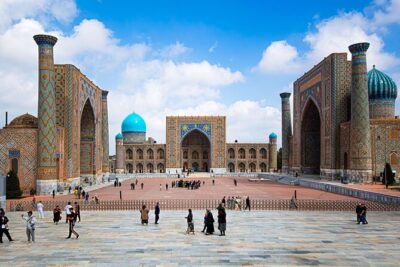 ★ 5.0Private Samarkand City Tour With TransportationFrom $54149 reviews
 ★ 5.0Full Day Private Tour in Seven Lakes from SamarkandFrom $10094 reviews
 ★ 5.0Best of Bukhara: All Day Private Old Town TourFrom $6566 reviews
★ 4.9Best of Bukhara: All Day Private Old Town TourFrom $6462 reviews
★ 5.0Best of Bukhara: All Day Private Old Town TourFrom $6566 reviews
★ 4.9Best of Bukhara: All Day Private Old Town TourFrom $6462 reviews
 ★ 5.0Bukhara Full Day Old City Private TourFrom $8546 reviews
 ★ 5.0Uzbekistan 6 days private tour Tas-Khiva-Buk-Sam-TasFrom $85045 reviews
 ★ 4.5Uzbekistan 8 Days Private Tour Tashkent-Urgench-Bukhara-Samarkand-TashkentFrom $97538 reviews
 ★ 4.8Tashkent: Private Full-Day City Tour on a Premium CarFrom $12538 reviews