
Review · SILK ROAD
Tashkent-Samarkand-Bukhara tour-3nights/4 days
A Silk Road trip in just four days. This private tour connects Tashkent, Samarkand, and Bukhara with guided stops, organized train travel, and the kind of on-the-ground context that turns monuments into stories. I like the way it stays practical, not vague, with transport, entry tickets, and a smooth day-by-day flow.
What I especially like is the pairing of major sights with everyday culture, like Chorsu Bazaar in old Tashkent and the deep medieval landmarks in Samarkand and Bukhara. I also appreciate the human touch: the team is friendly and thoughtful, which matters when your schedule is packed and your time is limited.
One thing to consider: the itinerary is time-tight and includes early starts on travel days, so if you prefer slow mornings, you will feel the pace.
In This Review
- Key highlights to know before you go
- Day 1 in Tashkent: Hazrati Imam, Chorsu Bazaar, and applied arts
- What day one feels like
- Traveling by Afrosiyab: how the train schedule shapes your trip
- The practical comfort of “organized transport”
- Day 2 in Bukhara: Sitorai-Mokhi-Khosa and a first sense of scale
- Day 3 in Bukhara: Poi Kalyan, the Ark, and the city’s quiet core
- The tradeoff on day three
- Day 4 in Samarkand: Gur Emir to Shah-i Zinda
- Price and value: what $1,200 really covers
- Who this tour is best for
- Small things that make a big difference
- Should you book this Tashkent-Samarkand-Bukhara tour?
- FAQ
- What is the start time and meeting point for this tour?
- Is pickup available, or do I need to find the departure point myself?
- How long is the tour?
- What transport is included between the cities?
- Are breakfasts included?
- What is included for sightseeing?
- What is the cancellation policy?
Key highlights to know before you go
- Old Tashkent plus a real bazaar stop, so you get more than just tile and tombs
- High-speed train legs timed into the day, minimizing wasted transit hours
- Bukhara’s medieval cluster in one run, from Poi Kalyan to the Ark of Bukhara
- Samarkand’s signature arc: Gur Emir, Registan, Ulugh Beg Observatory, Shah-i Zinda
- Hotel stays in all three cities, with breakfasts included to reduce daily planning stress
- Private tour for your party, with a guide who can answer questions on the spot
Day 1 in Tashkent: Hazrati Imam, Chorsu Bazaar, and applied arts
Your tour starts at 7:00 am at Hotel Uzbekistan (Mirzamakhmud Musakhanov Street 45, Toshkent). You can also request pickup if finding the departure point feels annoying, which is a small detail that can save a lot of stress on day one.
The day builds a smart first impression: religion, commerce, and craft. The centerpiece is the Ensemble Hazrati Imam, the religious heart of Tashkent in the old city. You visit the Barak Khan madrasah (16th century) and the Kaffal Shashi maus (the focus is medieval religious memory, not just architecture). Even if you have seen a lot of Islamic sites before, this complex is a good way to get your bearings fast in Tashkent.
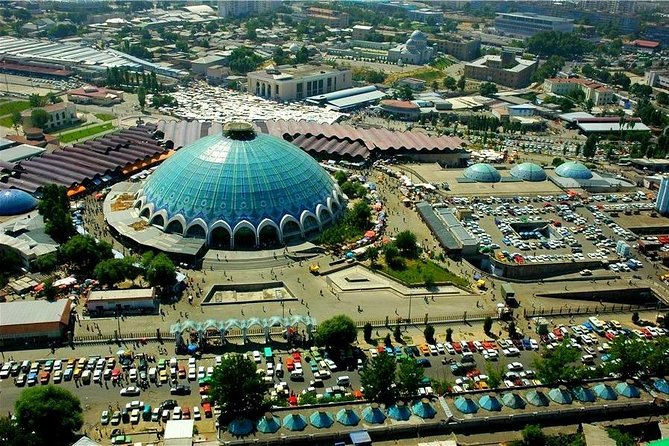
Then you shift to daily life at Chorsu Bazaar, one of the largest bazaars in Uzbekistan and Central Asia. You get a short visit (about 40 minutes), but it hits a key purpose. Markets like this are where the Silk Road story stops being a textbook theme and becomes something you can feel in the layout, the rhythm, and the trade atmosphere.
Next is Kokaldash Madrasah, built in 1569, known as the largest of the 23 madrasahs of old Tashkent. This is the moment where a guided visit earns its keep. A good guide can explain not only what you are looking at, but why these institutions were built where they were and what role they played beyond religious education.
You end the day with the Uzbekistan State Museum of Applied Art, founded in 1937, built on a temporary handicrafts exhibition. The museum has over 4,000 exhibits in decorative art. This is a nice contrast to the outdoor monument stops. It gives you craft details that are often hard to spot when you are rushing between squares and mausoleums.
Finally, you round out the city with central landmarks like Amir Temur Square. This part is less about deep research and more about place. It helps you understand how modern Tashkent frames its identity next to its older core.
What day one feels like
Expect a steady walking rhythm with short time windows for each stop. It is not the type of day where you disappear into one place for hours. That is a plus if you want efficiency, and a minus if you like lingering.
Longer Silk Road itineraries we have read
- 2 Days Tour to Bukhara and Samarkand from Tashkent by train
★ 5.0 · 53 reviews - Magic Land Tour to Uzbekistan
★ 5.0 · 49 reviews - Uzbekistan 6 days private tour Tas-Khiva-Buk-Sam-Tas
★ 5.0 · 45 reviews - Uzbekistan Silk Road
★ 5.0 · 39 reviews
Traveling by Afrosiyab: how the train schedule shapes your trip
The tour is built around high-speed train connections, using Afrasiyab economy tickets for the legs:
- Tashkent to Bukhara, about 600 km, around 3 hours 50 minutes
- Bukhara to Samarkand, leaving 15:50, arriving 17:15
- Samarkand to Tashkent, leaving 17:30, arriving 19:40, about 2 hours 10 minutes
This matters for two reasons.
First, it keeps the trip from turning into a full-day bus grind. Second, it creates a predictable rhythm. You wake, grab breakfast, move by car to the station, ride fast, and then you still have sightseeing time the same day.
Day 2 starts early. Breakfast is listed for 05:30 to 06:00, checkout and transfer happens at 06:30, and arrival in Bukhara is at 11:15. That is the moment where you decide whether you are a morning person or not. If you are not, plan to go to sleep earlier than usual.
The practical comfort of “organized transport”
The tour includes all trips and transfers in a comfortable car as per the itinerary. That reduces the usual pain points in Central Asia travel, like figuring out station logistics or bargaining for rides mid-journey. You spend your energy on the sights, not the logistics.
Day 2 in Bukhara: Sitorai-Mokhi-Khosa and a first sense of scale
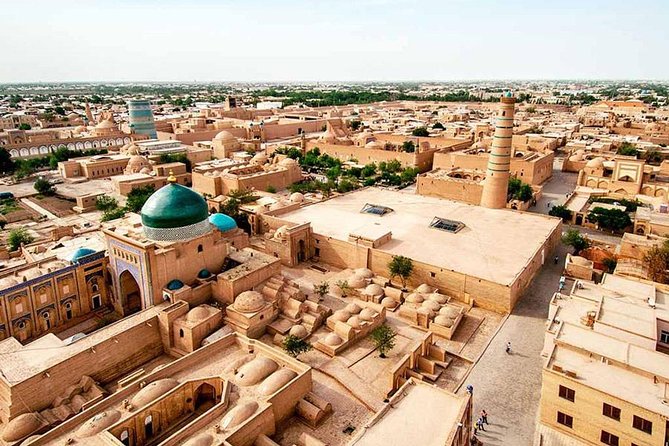
On arrival in Bukhara at 11:15, your key stop is the Palace of Moon-like Stars (Sitorai-Mokhi-Khosa). You have about 3 hours here, and that time window is useful. Palaces and palace-madrasah blends often reward a slower look, and 3 hours is long enough to take in rooms and details without rushing every corner.
This stop also sets the tone for the rest of the journey. Bukhara’s power is not just in one monument. It is in how the city layers its eras. A guided visit helps you connect what you see today to what it likely meant when it was in use, especially around religious and elite life.
By the time you move on later in the tour, you will start seeing Bukhara as an entire medieval system, not a random set of attractions. That is why starting with a palace is smart.
Day 3 in Bukhara: Poi Kalyan, the Ark, and the city’s quiet core
Day 3 is the densest Bukhara day on the schedule, and it is arranged like a strong storyline: worship and learning, fortress power, then everyday city calm.
You begin at Magoki Attori Mosque and carpet museum. The Magoki Attari Mosque is described as a medieval structure, with a column-domed form dating to the 12th to 16th centuries. The standout detail is its location: the mosque sits more than 4.5 meters below ground level. That one fact alone makes it feel different from many “surface level” monuments. It hints at layers of rebuilding and changing city life around it.
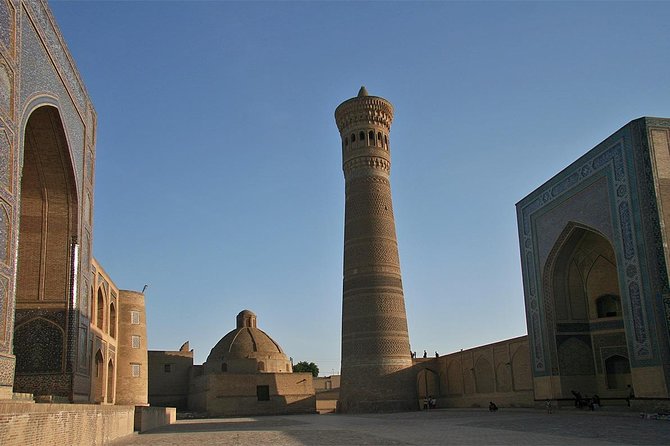
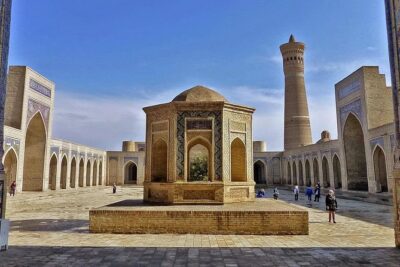
Then you move to the Great Minaret of the Kalon within the Poi Kalyan ensemble. This complex includes the Kalyan minaret, the Kalyan mosque, and the Miri Arab madrasah, built between the 12th and 16th centuries. You get about 40 minutes. It is a compact visit, but Poi Kalyan is the kind of place where your guide’s explanation can turn the structure into a mental map of the city’s religious focus.
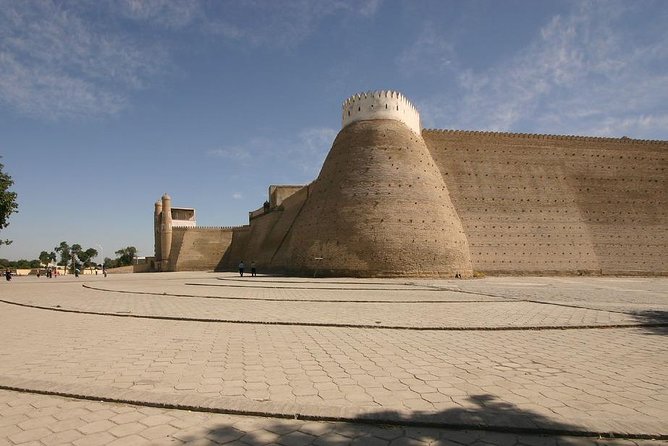
Next is the Ark of Bukhara, an ancient citadel rising almost 20 meters above surrounding ground and covering about 4 hectares. You get about 1 hour. The Ark is a powerful contrast to the spiritual landmarks. If the mosques and madrasahs represent belief and education, the Ark represents control: the administrative and military face of the city.
After that, you head toward Lyab-i Hauz Ensemble, which is described as the most popular Bukhara tourist attraction, known for grandness, tranquility, and age. This is often the stop that makes the day feel human again. After big monuments, a calm square area lets your brain reset.
The day ends with a transport move. At 15:50, you take the Afrasiyab high-speed train to Samarkand, arriving 17:15. You overnight in Samarkand.
The tradeoff on day three
This is a lot of ground covered in one day, but it is the kind of busy that makes sense. Your stops are linked by theme, not just geography. If you hate rushing, plan to bring patience and water, because you will be moving between several major sites.
Day 4 in Samarkand: Gur Emir to Shah-i Zinda
Samarkand is where the tour becomes more dramatic. Day 4 packs the city’s most recognizable landmarks into one final run, and you finish with a fast return to Tashkent.
You start at Gur Emir Mausoleum, associated with Tamerlane, his mentor Mir Sayyid Barak, and other members of the Timur family. You have about 1 hour. This is a good opener for Samarkand because it anchors the rest of the day in the Timurid story. Even if you do not know the names yet, your guide can connect them as you move from mausoleum to public squares.
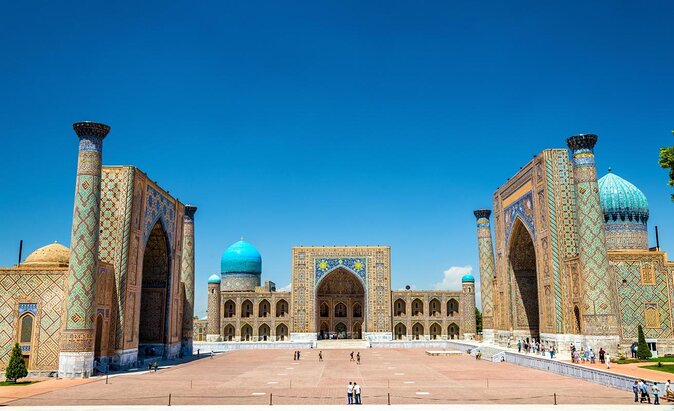
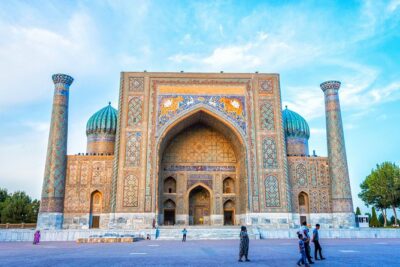
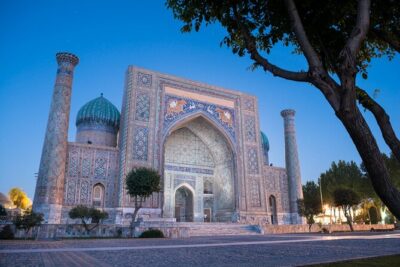
Then it is Registan, the famous square with three madrasahs: Ulughbek (15th century), Shirdar (17th century), and Tillakori (17th century). You get about 1 hour. Registan is one of those places where the architecture does not feel flat. It feels like a stage. The guided explanation is especially helpful here because the buildings function as a visual argument about power and education.
Next you visit the Ulugh Beg Observatory, built on Kuhak Hill in the vicinity of Samarkand between 1424 and 1428. The stop is about 40 minutes. Observatories can feel dry if you are not told what to look for, but the payoff is that it connects medieval scientific ambition with the city’s elite culture.
Then you go to Shah-i Zinda, described as an ensemble of mausoleums of Karakhanid and Timurid nobility. You get about 1 hour. This is a good final “visual memory” stop because it is about repetition and procession, and it stays with you after the day ends.
The itinerary also includes Bibi Khanum Mosque (listed as part of the day). It dates to 1399 to 1404 and is described as a grandiose cathedral mosque rich in tiles, carved marble, and murals. That kind of detail is exactly what a guided stop helps with, because you can focus your eyes on the right things.
Finally, you return to Tashkent. At 17:30, you take the Afrasiyab train back, arriving around 19:40.
Price and value: what $1,200 really covers
At $1,200 per person for a 4-day, multi-city private tour, the big question is value. Here is what you are paying for, based on what the package includes:
- Hotel stays in twin basis in Tashkent, Samarkand, and Bukhara
- Breakfasts (3 total, listed for those cities)
- Comfortable car transfers for the itinerary
- High-speed train tickets in economy for the three legs
- Entrance tickets for the sights listed as included
- All taxes (as stated in the included section)
That bundle is the core value. You are not just buying sightseeing. You are buying the removal of planning friction, the train booking structure, and guide navigation across multiple cities.
What is not included is also important:
- Lunches and dinners
- Tips
- International air tickets
- Hotel late check out and early check in
- Photography and video making fees at the sites
- Personal expenses
So the real decision is how you eat and how you like to handle extra site charges. If you prefer simple meals and you do not care about paid photography, the package can feel like a straightforward deal. If you want long sit-down lunches, premium dinners, or you plan to film a lot, you should budget extra.
Who this tour is best for
This is a strong fit if you:
- want a private tour experience but still want someone else to manage the schedule
- prefer fast connections between cities rather than slower overland travel
- like seeing big-name sites, like Registan and Gur Emir, with context from a guide
- appreciate cultural variety, since you get Chorsu Bazaar plus museums plus major monuments
It may not be ideal if you:
- hate early mornings. Day 2 requires breakfast in the pre-dawn window and a 06:30 departure
- prefer lots of free time to wander without a set sequence
Small things that make a big difference
One of the best “luxury” elements here is how the stops are paced. You are not trapped in a single location all day, but you also are not moved every 15 minutes. Many sightseeing blocks are around 40 to 60 minutes, which is enough time to actually look, read plaques, and ask questions.
Also, this tour leans into the practical side of travel. It even prompts you to ask the guide for authentic Uzbek meal recommendations. That matters because local food advice can save you from guessing, especially when lunches and dinners are not included in the package.
And the team quality shows in the feedback themes you can expect to feel on the ground: friendly, thoughtful support. When your days are packed and your train times are fixed, that kind of guidance helps more than you might think.
Should you book this Tashkent-Samarkand-Bukhara tour?
I would book it if your goal is a high-value Silk Road overview with real guidance and zero itinerary headaches. The combination of private touring, hotel stays across all three cities, and Afrasiyab train legs is exactly what makes it efficient for limited time.
I would think twice if you need slow mornings, long free wandering time, or you know you will want heavy filming and paid photography at multiple sites, since those fees are not listed as included.
If you want a classic route, tight organization, and a guide who can help you understand what you are seeing, this one makes a lot of sense.
FAQ
What is the start time and meeting point for this tour?
The tour starts at 7:00 am. The meeting point is Hotel Uzbekistan, Mirzamakhmud Musakhanov Street 45, Toshkent, Uzbekistan.
Is pickup available, or do I need to find the departure point myself?
Pickup is offered if it is easier for you. You can also be instructed to easily find the departure point in Tashkent.
How long is the tour?
The tour lasts about 4 days.
What transport is included between the cities?
The tour includes high-speed train tickets by Afrosiyab (economy) for Tashkent to Bukhara, Bukhara to Samarkand, and Samarkand to Tashkent. Comfortable car transfers are included as per the itinerary.
Are breakfasts included?
Yes. Breakfast is included (3 breakfasts) in Tashkent, Samarkand, and Bukhara.
What is included for sightseeing?
Entrance tickets are listed as included for the sights marked with admission included in the itinerary. The tour also organizes transport and guide services for the stops.
What is the cancellation policy?
You can cancel for a full refund up to 24 hours in advance of the experience start time. Free cancellation applies if you cancel at least 24 hours before.
More Tours Around Uzbekistan
The Full Uzbekistan Review Pile
Whole Country Itineraries


More of Uzbekistan we have reviewed
- Uzbekistan 6 days / 5 nights tour★ 5.0 · 3 reviews
- Tashkent Mountain Tour Amirsoy with Transport★ 3.5 · 3 reviews
- Private Tashkent City Tour★ 5.0 · 3 reviews
- Transfer Tashkent Airport / Railway Station – Hotel★ 3.5 · 3 reviews
- Tashkent: 3-Day Horseback Riding Tour in Chimgan Mountains★ 4.4 · 3 reviews
- Samarkand: Uloq-Kopkari (Buzkashi) Game Day Tour★ 5.0 · 3 reviews
Multi-Day Uzbekistan & Silk Road Tours, compared.
 ★ 5.02 Days Tour to Bukhara and Samarkand from Tashkent by trainFrom $49953 reviews
 ★ 5.0Magic Land Tour to UzbekistanFrom $1,24749 reviews
 ★ 5.0Uzbekistan 6 days private tour Tas-Khiva-Buk-Sam-TasFrom $85045 reviews
 ★ 5.0Uzbekistan Silk RoadFrom $1,23039 reviews
 ★ 4.5Uzbekistan 8 Days Private Tour Tashkent-Urgench-Bukhara-Samarkand-TashkentFrom $97538 reviews
 ★ 4.5Uzbekistan 3 Day Private Tour Tashkent-Bukhara-Samarkand Bullet TrainFrom $50023 reviews
 ★ 5.0Colourful UzbekistanFrom $2,19715 reviews
 ★ 5.0Private Multi-Day Tour to Ancient Cities UzbekistanFrom $1,82215 reviews
Browse the lists this tour appears in