
Review · SILK ROAD
Magic Land Tour to Uzbekistan
Uzbekistan hits you in waves, not stops. On the Magic Land Tour to Uzbekistan, you link the famous Silk Road cities with countryside days, then cap it with local overnights that feel far from a standard checklist. I especially love the Khast Imam complex in Tashkent, with the preserved Uthman Quran, and I love the chance to sleep in a yurt camp and then in a family home in the Sentyab village area.
One possible drawback to note: the schedule is full and timing is fixed, so you will need decent energy for early starts and long sightseeing days. If you prefer lots of free time or slower pacing, this plan might feel a bit tight.
At $1,247.70 per person, the value comes from what is already handled: hotels with breakfast, monument entrances, local guides in multiple cities, high-speed train tickets, and even a prepaid SIM card.
In This Review
- Key highlights before you go
- Entering Tashkent’s Old City: Khast Imam and Chorsu Bazaar
- Getting from Tashkent to Bukhara fast: the Afrosiyob day
- Bukhara in two moods: city monuments, then countryside calm
- Gijduvan ceramics to Nurata’s Chashma Spring and kariz systems
- Aydar Lake and Sentyab village: where the tour becomes personal
- Riding into Samarkand: plov lunch and a smooth transition
- Samarkand’s must-sees: Registan, Gur-Emir, Shakhi-Zinda, and the Meros paper mill
- Shakhrisabz via mountain pass: Aman-Kutan Gorge, Teshiktosh, and Ak Saray ruins
- The logistics that make this tour feel easy: guides, SIM card, and 24 hour support
- Price and value: what $1,247.70 really buys
- Should you book the Magic Land Tour?
- FAQ
- How long is the Magic Land Tour to Uzbekistan?
- Where does the tour start and end?
- Which cities and main stops are included?
- Are the high-speed trains included?
- Are entrance tickets included for monuments and museums?
- Is Uzbekistan visa support included?
- What meals are included, and what is not?
- Is a SIM card provided?
- What is the cancellation policy?
Key highlights before you go
- Khast Imam in Tashkent, including the Uthman Quran complex and major religious buildings
- Afrosiyob high-speed train connections that reduce travel time between cities
- Bukhara’s main architectural cluster, from Lyabi-Khauz to Kalyan Minaret and Ark Fortress
- Gijduvan ceramics and Nurata water systems, including kariz underground pipelines
- Night-sky country stays, first at a yurt camp, then with a local host family in Sentyab
- Samarkand essentials in a single loop, Registan Square, Gur-Emir, Shakhi-Zinda, and a working paper mill
Entering Tashkent’s Old City: Khast Imam and Chorsu Bazaar
Your trip starts in Tashkent, and it wastes no time getting you into the historic core. After pickup from Tashkent International Airport, you check in later that afternoon and then head straight to the Old City area. The first big stop is Khast Imam, a religious center packed into one architectural complex.
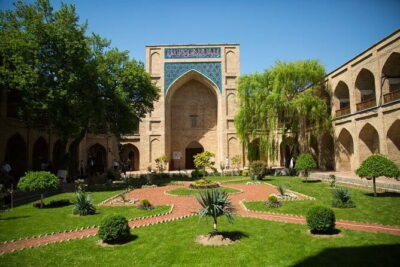
Inside Khast Imam you’ll see major linked sites such as Barak-Khan Madrasah, Tillya Sheikh Mosque, Muyi Muborak Madrasah, Kaffal Shashi Mausoleum, New Khazrati Imam Mosque, and the Muftiate building. This is also where the Uthman Quran has been preserved, so it’s not just pretty tiles. It’s a key place for understanding Uzbekistan’s religious and cultural continuity.
From there, you drive to Chorsu Bazaar, one of those markets that helps you get your bearings fast. It’s a practical way to experience daily life, plus it’s a good moment to buy small items like snacks or simple souvenirs without turning it into a shopping spree. The day wraps with a visit to the State Museum of Applied Art, which is a smart choice after religious architecture, because it shifts you from sacred spaces to everyday craft.
Getting from Tashkent to Bukhara fast: the Afrosiyob day
If your biggest fear about touring is losing half your day to slow transport, this itinerary handles that well. On Day 2 you transfer to the train station in the early morning and take the high-speed Afrosiyob to Bukhara. You arrive mid-morning and can start sightseeing the same day, without feeling like travel stole the highlight hours.
Bukhara is best when you walk it, and this tour does exactly that after you store luggage at the hotel. You focus on the classic old-city monuments, moving from square to mosque to fortress. You’ll visit the Lyabi-Khauz Complex, Magoki-Attori Mosque, Chor-Minor Madrasah, and the Trade domes, then continue through the heart of the skyline with the Kalyan Minaret and Kalyan Mosque.
The itinerary also includes Miri-Arab Madrasah, the Ulugbek and Abdulazizkhan madrasahs, plus the Ark Fortress. That mix matters. Ark Fortress gives you the ruling power story, while the madrasahs and mosques show how education and faith shaped urban life. You also go to Bolo-Khauz Mosque, and you’ll see points like Chashma-Ayub and the Ismail Samani mausoleum, which anchor the city beyond just the most famous angles.
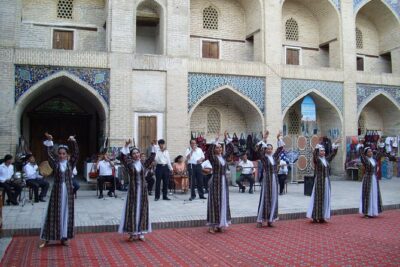
Dinner is handled at Nodir Devonbegi Madrasah Restaurant, with a traditional dance show. This is one of those included details that saves you from decision fatigue. You get a planned evening cultural moment instead of trying to guess what to find on your own after a long day of walking.
Longer Silk Road itineraries we have read
- 2 Days Tour to Bukhara and Samarkand from Tashkent by train
★ 5.0 · 53 reviews - Magic Land Tour to Uzbekistan
★ 5.0 · 49 reviews - Uzbekistan 6 days private tour Tas-Khiva-Buk-Sam-Tas
★ 5.0 · 45 reviews - Uzbekistan Silk Road
★ 5.0 · 39 reviews
Bukhara in two moods: city monuments, then countryside calm
Day 3 slows things down just enough to feel like a real break. You start with breakfast, then later head out for countryside sightseeing around Bukhara. The first major stop is the summer residence of Bukhara’s last emir, Sitorai Mokhi-Khosa. It’s the kind of visit that helps you understand how power lived when the city’s religious sites were paired with elite domestic life.
Next comes the Bakhouddin Naqshbandi Mausoleum, followed by the Chor-Bakr Necropolis. This pairing works well because it gives you both a spiritual landmark and a landscape of memory in the necropolis setting. If you’re the type who likes symbolism, these stops offer meaning without needing extra lectures.
You return to the hotel with free time in the late part of the day. That “breathing room” is important here because Bukhara days can run long. You’ll likely want a little downtime to sit, snack, and recharge before tomorrow’s shift toward Nurata and the countryside.
Gijduvan ceramics to Nurata’s Chashma Spring and kariz systems
On Day 4, the route moves beyond the big-city monuments and into craft and engineering. After breakfast you drive toward Gijduvan, stopping at a ceramics workshop. This is a good moment to see the skill behind the famous blue tiles you’ve been seeing on buildings, because ceramics are part of Uzbekistan’s everyday visual language.
Then the day turns toward Nurata. After lunch in the area, you visit Chashma Spring, one of the key natural landmarks. From there, you go uphill to see remains of the fortress of Alexander the Great. The tour also includes the kariz underground water pipeline system near Nurata, noted as being connected with Alexander the Great.
This combination is worth your time because it shows two ways humans adapt to geography. Springs feed communities in visible ways. Kariz systems are hidden and technical, but they’re the reason settlement survives in harsher terrain. Even if the historical layers don’t all matter to you personally, the physical idea is clear: water access is everything.
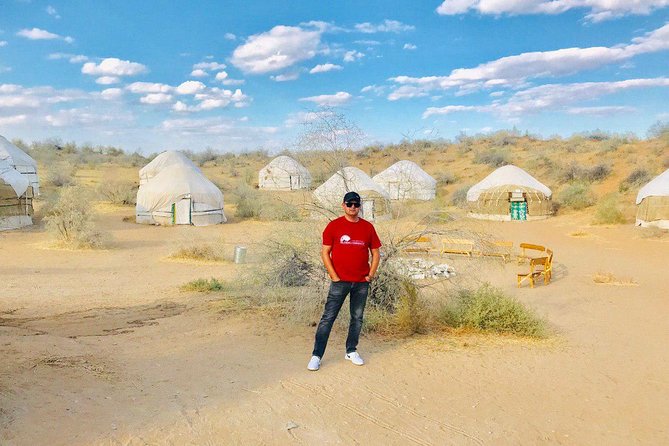
That day ends at a Yurt Camp, where you spend the night. This is where the tour stops being only museums and becomes more about experience. You’ll likely appreciate the change of pace, especially after walking-heavy days in Bukhara.
Aydar Lake and Sentyab village: where the tour becomes personal
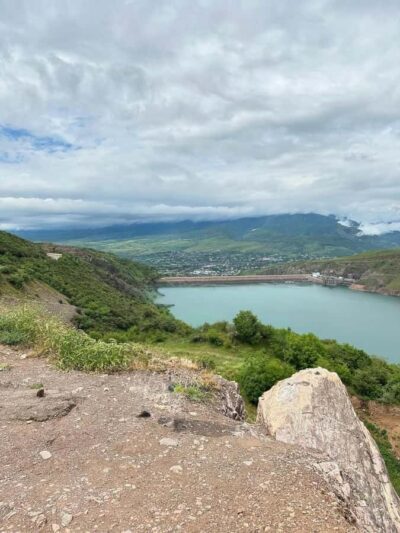
Day 5 starts with breakfast at the yurt camp and then heads to Lake Aydar. You stop and watch along the lakeshore before continuing to Sentyab village. Arrival includes lunch with a local family, and the best part is that your day has built-in flexibility: you get free time for hiking and then dinner with your host.
The overnight here is a big part of why this tour stands out emotionally from a typical urban loop. You sleep in a traditional house with a host family. That setup is not about luxury. It’s about being part of daily rhythms for a night, and you’ll come away with a better feel for what life looks like outside the souvenir-driven city center.
Practically speaking, this also means you should come prepared with a flexible mindset. You might find the comforts different from city hotels, but the itinerary is clearly designed to give you a real human connection, not a quick photo stop and leave.
Riding into Samarkand: plov lunch and a smooth transition
Day 6 moves you to Samarkand by car. After breakfast with the family, you drive around midday and arrive in Samarkand at 12:30. Lunch is prearranged as luxury plov, which is a great choice here because it’s local comfort food and an easy way to fuel up before the sightseeing that follows.
Once you’re transferred to the hotel, you get free time and another overnight. That free time matters because Samarkand can hit fast, with a lot of major sites in a short span. Give yourself a chance to freshen up and plan your energy.
If you’re traveling with older family members or you want smoother days, this is where you’ll thank the schedule. You’re not thrown into monument after monument immediately on arrival.
Samarkand’s must-sees: Registan, Gur-Emir, Shakhi-Zinda, and the Meros paper mill
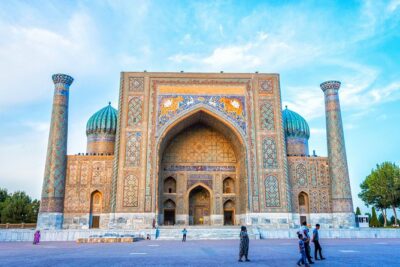
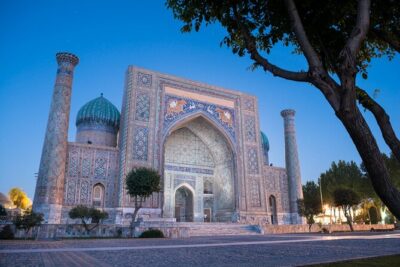
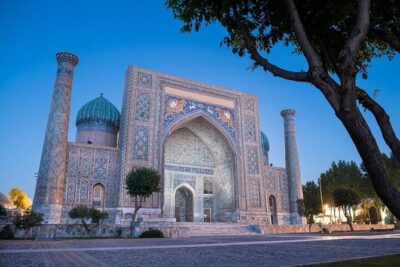
Day 7 is the heavy-hitter day. You start with breakfast, then your morning includes Gur-Emir Mausoleum, Registan Square, Bibi-Khanum Mosque, and Siab Bazaar. Each stop changes the angle of the story.
Gur-Emir gives you the sense of dynasties and power. Registan Square is the visual centerpiece, all scale and symmetry. Bibi-Khanum Mosque adds grandeur on a different scale, and Siab Bazaar gives you an everyday contrast so the day doesn’t turn into only monuments.
After lunch, you continue with Khazrat Khizr Mosque, the Mausoleum of the first President of Uzbekistan Islam Karimov, and Shakhi-Zinda Necropolis. Then you add Ulughbek Observatory, plus the Mausoleum of Saint Daniel. That last group helps you see how Samarkand combined science, faith, and legend across eras.
The day doesn’t end with architecture. You also visit the “Meros” paper mill in Konigil village. That’s a clever final touch because you shift from tilework to something more grounded and industrial. It’s also a memorable way to understand how paper was made, not just how empires displayed power.
Shakhrisabz via mountain pass: Aman-Kutan Gorge, Teshiktosh, and Ak Saray ruins
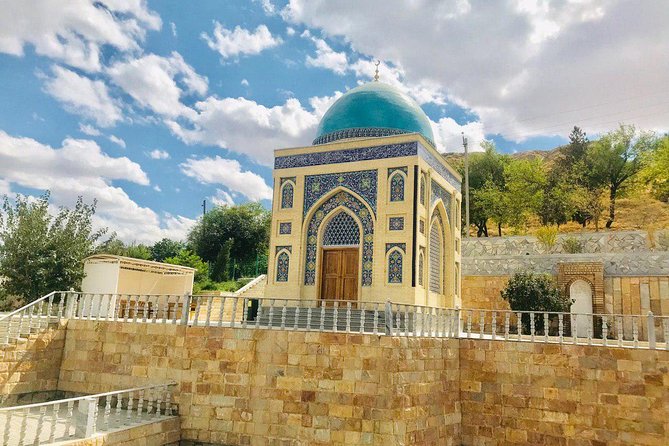
Day 8 is where scenery and road travel become part of the attraction. You transfer to Shakhrisabz, about 85 km away, and the route includes the Aman-Kutan Gorge and the Takhta-Karacha Mountain Pass.
On the way, you stop at Teshiktosh, a stone with a hole, and the tour notes that the film Apachen (1973) was shot there. You also get a short stop at the top of the mountain pass, plus a tiny market where you can buy dried fruits. That little market moment is not just snack time. It helps you treat the drive like a travel day, not a chore.
Once in Shakhrisabz, you visit the Mausoleum of Jakhongir in the Dor-us Saodat Memorial Complex, then the remains of Ak Saray Palace, and Kok Gumbaz Mosque. These stops matter because Shakhrisabz is tied to Timur-era ambition, and you can see how planned grandeur shows up even when buildings are in ruins.
In the afternoon you drive back to Samarkand and transfer to the station for the Afrosiyob train back to Tashkent. Arrival in Tashkent is in the evening, and you’re transferred to the hotel for the final overnight.
The logistics that make this tour feel easy: guides, SIM card, and 24 hour support
One thing I appreciate about this kind of itinerary is how many stressful parts are removed. You get airport and train station pickup and drop-off, plus local transportation throughout the tour. You also get local tour guide services in Tashkent, Bukhara, Samarkand, and Shakhrisabz.
From the feedback around this operator, Anvar is often mentioned for staying in touch and responding quickly before and during the trip. And in Samarkand, a guide named Botir Temitov is highlighted for making the sites click. Even without meeting them personally, it’s a good sign when real people consistently connect service quality to named individuals.
The tour also includes a local prepaid SIM card with 5 GB internet access. That’s practical in Uzbekistan, where having data on your phone makes it easier to navigate and handle small questions without hunting down Wi-Fi.
Food is partly planned and partly flexible. Breakfast is included, and you also have included lunches and dinners on specific days. For meals not included, you pay directly at places you stop. This balance is useful because it prevents the itinerary from forcing one restaurant for every meal, but you still get key cultural dinners built in.
Price and value: what $1,247.70 really buys
$1,247.70 per person is not a budget number for most travelers. The good news is that the price is tied to concrete services, not just a big label.
Here’s where your money goes:
- Accommodation in double or twin shared rooms, with breakfast
- Entrance tickets to the monuments and museums on the itinerary
- Local guide services across the main cities
- Airport and train station transfers, plus transportation during the tour
- Afrosiyob economy class high-speed train ticket segments
- A local prepaid SIM card with 5 GB internet access
- Uzbekistan visa support via an LOI, plus 24 hour customer service
The biggest “value lever” is the high-speed train and the included guided sightseeing across multiple cities. Another strong lever is that you’re not only doing city sights. You get Gijduvan ceramics, Nurata water systems, plus the yurt camp and the Sentyab home stay. That mix is what makes the trip feel more complete than a pure monument tour.
If you’re comfortable paying for a few extra meals yourself, the structure is likely to feel fair. If you want every lunch and dinner handled without decisions, you may find the paid meals requirement slightly annoying.
Should you book the Magic Land Tour?
Book this tour if you want a well-timed route across Uzbekistan that includes Tashkent, Bukhara, Samarkand, Shakhrisabz, and meaningful countryside stops. It’s especially a good fit if you like guided history but also want nights in places you cannot easily replicate on your own.
Skip it or consider a different option if you hate early mornings or you need a lot of free time to wander at your own speed. The plan is full, and you’ll walk. Also, it’s built for moderate physical fitness, so take that seriously if you have mobility limits.
Finally, if you’re the kind of traveler who values smooth logistics, this operator’s emphasis on pickups, guides, and ongoing support is exactly what you want. When the itinerary includes trains, guides in multiple cities, and even a SIM card, you spend less time managing problems and more time seeing Uzbekistan.
FAQ
How long is the Magic Land Tour to Uzbekistan?
The tour is listed as 9 days (approx.).
Where does the tour start and end?
The start is Tashkent International Airport, and it ends back at the meeting point.
Which cities and main stops are included?
The tour covers Tashkent, Bukhara, Nurata (with Yurt Camp nearby), Sentyab village (host family stay), Samarkand, and Shakhrisabz, with additional sightseeing in between.
Are the high-speed trains included?
Yes. The tour includes Samarkand to Tashkent high-speed train Afrosiyob ticket, and it also uses the Afrosiyob train for travel from Tashkent to Bukhara.
Are entrance tickets included for monuments and museums?
Yes. Entrance tickets to monuments and museums according to the itinerary are included.
Is Uzbekistan visa support included?
Yes. Uzbekistan visa support (LOI) is included.
What meals are included, and what is not?
Breakfast is included (8 breakfasts listed). Dinner is included for 3 evenings, and lunch is included for 2 days. Other lunches and dinners are not included and must be paid directly by you.
Is a SIM card provided?
Yes. A local prepaid SIM card with internet access (5 GB package) is included.
What is the cancellation policy?
Free cancellation is available. You can cancel up to 24 hours in advance of the experience’s start time for a full refund. If you cancel less than 24 hours before, the amount paid is not refunded.
More Tours Around Uzbekistan
The Full Uzbekistan Review Pile
Whole Country Itineraries

More of Uzbekistan we have reviewed
- Uzbekistan 6 days / 5 nights tour★ 5.0 · 3 reviews
- Tashkent Mountain Tour Amirsoy with Transport★ 3.5 · 3 reviews
- Private Tashkent City Tour★ 5.0 · 3 reviews
- Transfer Tashkent Airport / Railway Station – Hotel★ 3.5 · 3 reviews
- Tashkent: 3-Day Horseback Riding Tour in Chimgan Mountains★ 4.4 · 3 reviews
- Samarkand: Uloq-Kopkari (Buzkashi) Game Day Tour★ 5.0 · 3 reviews
Multi-Day Uzbekistan & Silk Road Tours, compared.
 ★ 5.02 Days Tour to Bukhara and Samarkand from Tashkent by trainFrom $49953 reviews
 ★ 5.0Uzbekistan 6 days private tour Tas-Khiva-Buk-Sam-TasFrom $85045 reviews
 ★ 5.0Uzbekistan Silk RoadFrom $1,23039 reviews
 ★ 4.5Uzbekistan 8 Days Private Tour Tashkent-Urgench-Bukhara-Samarkand-TashkentFrom $97538 reviews
 ★ 4.5Uzbekistan 3 Day Private Tour Tashkent-Bukhara-Samarkand Bullet TrainFrom $50023 reviews
 ★ 5.0Colourful UzbekistanFrom $2,19715 reviews
 ★ 5.0Private Multi-Day Tour to Ancient Cities UzbekistanFrom $1,82215 reviews
 ★ 5.011-Day Tour: Magical Cities of Uzbekistan! Discover The Great Silk Road with us!From $1,60010 reviews
Browse the lists this tour appears in