
Review · SILK ROAD
Uzbekistan 6 Days Private Tour Khiva-Bukhara-Samarkand by Train
Three cities, one clean itinerary. This private Khiva-Bukhara-Samarkand tour strings together the top monuments in the walled old towns and major squares, with a smooth rhythm of guided time and travel time. I especially like that it uses licensed local guides and includes museum/monument tickets, so you are not stuck negotiating lines or asking what to pay next.
The other big plus is how the logistics are handled for you. You get AC transport, airport pickup at Urgench, centrally located hotels for 5 nights, and train tickets for the Khiva to Bukhara and Bukhara to Samarkand legs. One consideration: expect photo and video charges at some sites paid in cash at the entrance, and train departure times can vary by day (15:00 or 18:00 out of Khiva).
In This Review
- Key things to know before you go
- How the train route shapes the whole trip
- Urgench arrival and Khiva’s Ichan Kala: stepping into a walled world
- The rest of Khiva’s highlights: mosques, palaces, and the Islam Khodja complex
- Day 2: a second pass in Ichan Kala plus the Khiva to Bukhara train
- Bukhara’s big ensembles: Lyab-i Hauz, Po-i Kalyan, Ark, and more
- Day 4 free time in Bukhara, then the Kagan station transfer to Samarkand
- Samarkand’s golden triangle: Gur Emir, Registan, Bibi Khanym, and Shah-i-Zinda
- Day 6: fly out from Samarkand
- Price and value: is $800 per person a smart deal?
- Practical tips so this tour feels smooth
- Should you book this private train tour of Khiva, Bukhara, and Samarkand?
- FAQ
- Which cities are included in this 6-day private tour?
- How do you travel between Khiva, Bukhara, and Samarkand?
- What is included in the tour price, and what is not?
- Is pickup provided when I arrive in Uzbekistan?
- Do you help with Uzbekistan visas?
- What is the cancellation deadline for a full refund?
Key things to know before you go
- Private group, not a cattle line: it is set up as a private tour, so your timing and pacing depend on your group.
- Tickets included for most monuments: entrance tickets to museums and major sites are part of the package.
- Train travel between cities: you avoid long road days and keep the trip feeling like one continuous circuit.
- Old city walking is real: Khiva and Samarkand are built for steps, so comfortable shoes matter.
- Cash for photo/video fees: some museums charge extra for photos or video at the door.
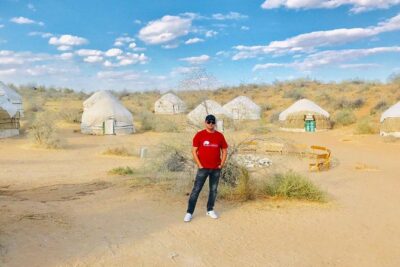
- You can tweak the route: there is an option to enhance with a desert or mountain detour (small or no extra charge depending on what you choose).
How the train route shapes the whole trip
This is the kind of itinerary that works because it respects geography. Khiva, Bukhara, and Samarkand are far enough apart that day-after-day road transfers can feel tiring. Here, you use trains for the longest jumps, then keep the sightseeing focused inside each city’s historic core.
You also get a practical mix of “show me” guidance and real free time. The plan includes guided blocks at the big sites, then leaves room in Bukhara for you to roam and hunt down smaller monuments or simply sit with tea and watch the square for a while.
Finally, the tour is set up to reduce the little frictions that can spoil a short trip. You have a set pickup process at Urgench Airport, centrally located hotels for all nights, and a 24-hour customer service contact if something changes.
Urgench arrival and Khiva’s Ichan Kala: stepping into a walled world
Day 1 starts at Urgench Airport. Your driver meets you at the Arrival Hall exit with a name shield, then the tour moves you into Khiva’s historic inner city.
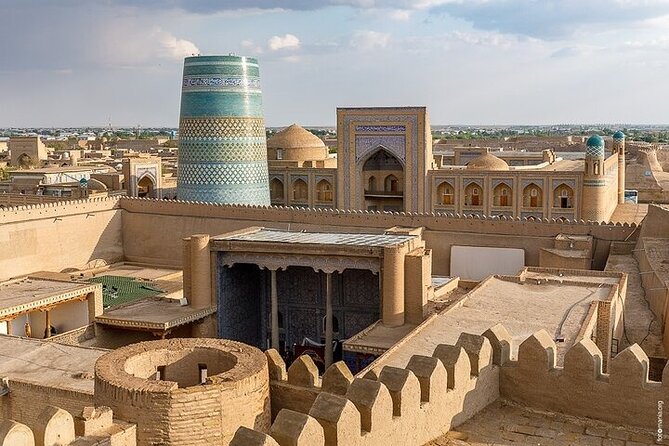
Ichan Kala is where Khiva becomes more than a stop on a map. This old city is an enclosed zone about 26 hectares, built as a rectangle roughly 650 by 400 meters, and surrounded by fortification walls that can reach up to 10 meters high. It has the feel of a working time capsule, with the khan’s palace and elite residences in one part and the everyday spaces for craftsmen and merchants in Dishan Kala outside the walls.
You begin with Ichan Kala itself, then layer in the landmarks people travel for:
- Kalta Minor Minaret: a glazed-tile marvel commissioned in 1851 by Mohammed Amin Khan. It was planned to rise over 70 meters, but construction stopped at 29 meters, so the name Kalta Minor, or Short Minaret, became the story.
- Kunya-ark Citadel: located right in the heart of Ichan Kala, on the west ramparts north of the west gate. The citadel dates back to early construction around the 12th century, and it is the largest complex inside Khiva’s old town.
- Pakhlavan Makhmud Mausoleum: tied to a local poet and philosopher known for strength and healing. The site grew from modest origins into a major complex with a large blue-tiled dome.
From a practical standpoint, this day is paced to avoid burnout. You are in and out of sites within the same walled zone, so you are not constantly transferring across the city. The longer blocks here, like the Kunya Ark visit that runs about 2 hours, are where you get context for how power and worship worked together in Khiva.
The rest of Khiva’s highlights: mosques, palaces, and the Islam Khodja complex
After the core hits, Day 1 keeps going through the essential religious and elite architecture of Ichan Kala.
The tour includes:
- Juma Mosque (Friday Mosque): positioned nearly at the center of Ichan Kala, a logical place for Friday prayers and the reading of the ruling Khan’s name.
- Stone Palace, also called Tash Khauli: built between 1830 and 1838 by order of Allakuli-Khan. It is a good example of Khorezm architectural grandeur from that later period.
- Islam Khodja Complex: southeast of the main east-west street, including a madrasa and minaret. It is named after Islam Khodja, grand vizier and also first cousin of Muhammad Rahmi Bahadur II.
You’ll notice a pattern across these stops. Khiva’s story is told through a few big institutions: palace, citadel, mosque, and scholarly buildings, all packed into walkable space. That makes it easier for you to remember what you saw. One day does not just give you “photos,” it helps you connect the dots between politics, religion, and education.
If you are sensitive to heat, timing matters. The plan is fairly full on Day 1, so wear breathable layers and plan on taking breaks inside cool interiors when you can.
Day 2: a second pass in Ichan Kala plus the Khiva to Bukhara train
Day 2 gives you more time in Ichan Kala, which is a smart move for two reasons. First, the city is dense, so even with guided time you often want to circle back. Second, Khiva’s architecture has details that reward a second look once your eyes are trained.
You get about a 4-hour exploration block, then the tour transitions to the train. You transfer to the Khiva railway station for departure at 15:00 or 18:00, depending on the day of travel. The schedule is specific enough that you can plan meals and rest, but flexible enough that your actual departure hour may change.
Once you arrive in Bukhara, you transfer from Bukhara Train Station to your hotel. The transfer is short and low-stress, which helps because you have a full sightseeing day coming next.
Bukhara’s big ensembles: Lyab-i Hauz, Po-i Kalyan, Ark, and more
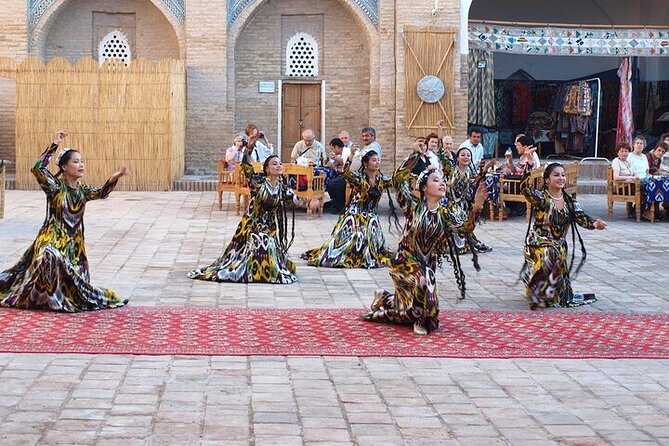
Day 3 is Bukhara’s main monument day. Bukhara is famous for its squares and ensembles, and the itinerary leans into that by grouping the key sights around a central flow.
Start with Lyab-i Hauz. This 16th to 17th century ensemble includes Nodir divan Begi Medressah, a khanaka, a water reservoir, and a caravan saray. It is a major square because it is tranquil and still feels like a place where daily life happens alongside tourism.
Next comes the Great Minaret of the Kalon at Po-i-Kalyan square. This complex includes the Friday Mosque and Mir Araba Medressah. The minaret rises to 45.6 meters and dates to 1127, predating the Mongol conquests. One of the most memorable details here is the legend that Genghis Khan refused to order its destruction because it impressed him.
Then you visit Ark of Bukhara, described as a royal town-within-a-town that served rulers for over a millennium. You walk through layers of Bukhara’s power structure, and it gives you grounding for how the city grew around the fortress.
After the main trio, the day adds variety:
- Bolo Hauz Mosque: built beginning in 1712, with the name meaning above the pool, referring to the octagonal hauz pond in front.
- Maghak-i ‘Attari Mosque: noted as the oldest surviving mosque of Central Asia. The structure also served as a budast and zaradustrian temple in earlier use, so it carries a layered religious story.
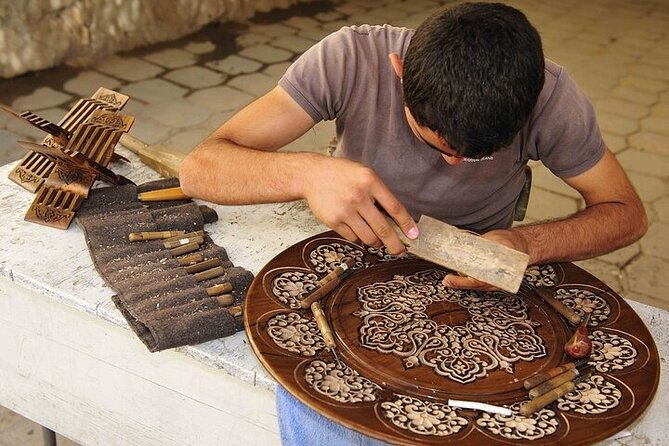
- Trading Domes: a medieval bazaar zone with artisan workshops. This is where you can shift from monuments to the everyday economy of the city.
The balance here is good. You get large iconic structures, then smaller moments where you see brickwork, craftsmanship, and how the bazaar supports the old-city vibe.
Day 4 free time in Bukhara, then the Kagan station transfer to Samarkand

Day 4 starts with a leisure block of about 4 hours in Bukhara. This is your chance to slow down. You can go back for photos from a different angle, visit additional monuments you are drawn to, or just take breaks where locals sit.
Then you transfer to Kagan Railway station, about 15 km away, to catch the train to Samarkand. The document notes it is subject to availability, which is the only part of the plan that is inherently less fixed. Still, the transfer time listed is short, about 20 minutes, so it should not swallow your whole day.
In Samarkand, you transfer to your hotel.
This day works best if you do not over-plan yourself. Treat the leisure time as flexibility. If you try to squeeze in too much, you’ll spend your limited energy running between sites instead of enjoying the city atmosphere.
Samarkand’s golden triangle: Gur Emir, Registan, Bibi Khanym, and Shah-i-Zinda
Day 5 is the big Samarkand day. The itinerary hits the famous monuments in an order that keeps momentum without making you feel rushed between far-apart zones.
You start with Gur Emir Mausoleum, associated with Tamerlane. The complex dates to 1404 to 1405 and was reconstructed across later periods. One standout detail is the mention of the largest piece of jade, greenstone, in the world.
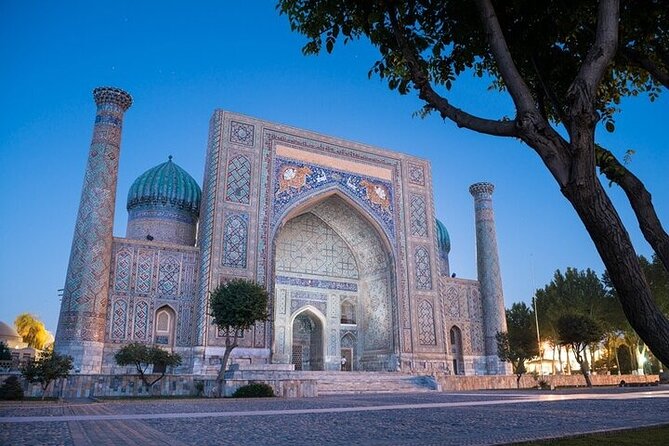
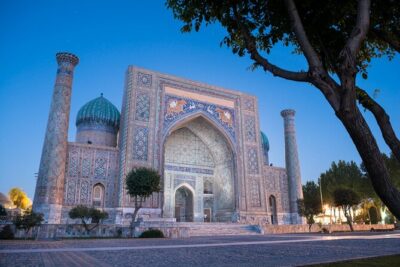
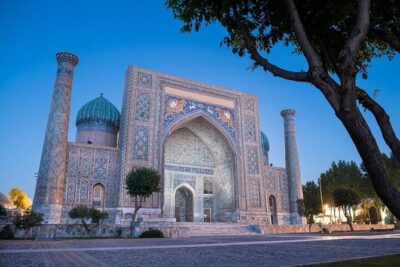
Then comes Registan, the city square that became central after life moved away from Afrosiab. Today it is surrounded by the three medreses: Ulugbek, Sherdor, and Tillokori. This is the place where you understand why Samarkand became legendary. You are surrounded by monumental façades, and the square’s scale makes the architecture feel like it is talking across centuries.
Next is Bibi Khanym Mosque. Built between 1399 and 1404 on Timur’s order, it is named after the wife of Temur. The itinerary notes it followed Timur’s combat of Delhi, and it even mentions the minaret was planned to be the tallest.
After that, the tour shifts to experiences that feel more lived-in:
- Siab Bazaar: known for produce and handicrafts, and a good place to remember that Uzbekistan is not only about architecture.
- Shah-i-Zinda: the ensemble on the southeastern mound of Afrosiab, made up of many mausoleums and tombs, with the note of 44 tombs in more than 20 mausoleums. It is tied to a religious figure listed as the first cousin of the Prophet Muhammad (PBUH), which is part of why the complex draws pilgrims.
Finally, you visit Ulugh Beg Observatory. Even with only foundations remaining, it feels special because you are seeing science, not just art. The itinerary points to what was preserved: a part of a huge sextant with a trench that is noted as 11 km.
This day is dense, but it is curated by theme. Power and empire with Gur Emir and Registan. Faith and legend with Bibi Khanym and Shah-i-Zinda. Science with Ulugh Beg.
Day 6: fly out from Samarkand
Day 6 is designed to be simple. You get a transfer to Samarkand Airport, then fly home. There is no last-minute monument scramble listed here, which is a relief if your previous days ran full.
If you like souvenirs, this is the day to do it the smart way. Pick up what you need near where you are already spending time, so you are not carrying bags around for hours on a departure day.
Price and value: is $800 per person a smart deal?
At $800 per person for about 6 days, the value depends on what you hate dealing with on your own. If you do not want to map out trains, negotiate entrance tickets across three cities, and line up licensed guides, this package is doing the heavy lifting.
Here is what you get that has real cost built in:
- 5 nights in centrally located 3-star or boutique hotels
- Air-conditioned transport
- Licensed experienced local guides in each city
- Entrance tickets to the museums and listed monuments
- Train tickets for the Khiva to Bukhara and Bukhara to Samarkand legs
- Breakfast (5)
That is why this tends to feel fair. You are paying for coordination and saved time. Even the “small extras” are handled transparently: photo and video charges at $1 to $2 per museum are not hidden, and you have a single-room supplement listed as $25 per night if you need privacy.
What is not included is also clear:
- Single room supplement ($25 per single room/night)
- Photo and video charges paid cash at entrances ($1 to $2 per museum)
- Tips for guides and driver
If you are traveling with a companion, the shared-room setup can make this price especially reasonable. If you are solo and need the supplement, your effective cost rises.
Practical tips so this tour feels smooth
A few small choices can make a big difference on a route like this.
Bring cash for site photo/video fees. The itinerary says you may need to pay $1 to $2 per museum in cash. Having small bills helps.
Wear shoes you can walk in. Khiva and Samarkand both reward stamina. You’ll be spending time inside complexes and walking between monuments.
Pack for heat and sun. The old-city areas are open-air, and even when the guide is moving you efficiently, you still spend time looking up at minarets and scanning courtyards.
Plan your pace around the longest day blocks. Days 1 and 3 are especially full. If you start strong on water, shade breaks, and snacks, you’ll enjoy the monuments more because you are not constantly catching your breath.
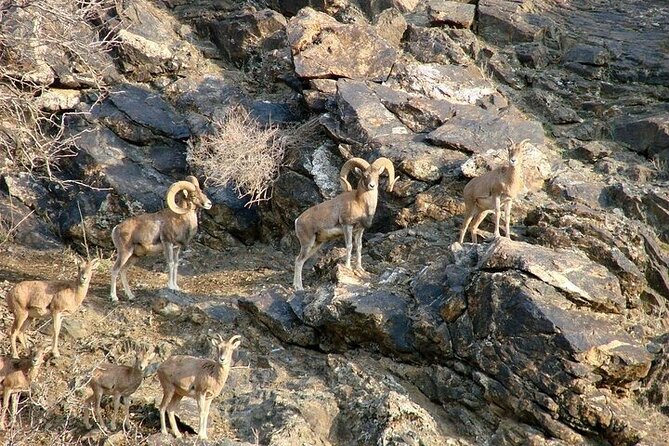
Use the custom detour idea if you want variety. The tour mentions you can enhance the trip with a desert or mountain detour option. If architecture days are your only focus, you can skip it. If you want scenery beyond city walls, it can add a different kind of memory.
Should you book this private train tour of Khiva, Bukhara, and Samarkand?
I think this is a smart booking if you want three of Uzbekistan’s biggest cities with minimal stress. The standout strengths are the tight guided flow, the fact that entrance tickets and trains are included, and the overall organization that keeps connections workable.
You should book if:
- you want a private setup where your group is not mixed into random pacing
- you prefer guided time for the big monuments instead of guessing what matters
- you like the idea of trains separating the long distances
You might hesitate if:
- you know you hate old-city walking and want a lighter schedule
- you are sensitive to extra cash costs for photo/video fees at entrances
- you want total freedom to change the day-by-day timing, since the itinerary has fixed sightseeing blocks and set train departure windows
If your goal is to see the headline sights in a structured, ticketed way, this tour fits that job well.
FAQ
Which cities are included in this 6-day private tour?
You visit Khiva, Bukhara, and Samarkand, with Urgench as your arrival point. The itinerary includes monuments inside Khiva’s Ichan Kala, major sites in Bukhara’s squares, and the top landmarks in Samarkand.
How do you travel between Khiva, Bukhara, and Samarkand?
You take a train from Khiva to Bukhara with a departure at 15:00 or 18:00 depending on the travel day. Then you transfer to Kagan Railway station (15 km) to take the train from Bukhara to Samarkand, subject to availability.
What is included in the tour price, and what is not?
Included items are entrance tickets to the museums, train tickets for the intercity legs, 5 nights of centrally located 3-star or boutique hotels, AC transport, licensed local guides, and breakfast for 5 days. Not included are the single room supplement ($25 per single room per night), photo and video charges paid cash at entrances ($1 to $2 per museum), and tips for guides and the driver.
Is pickup provided when I arrive in Uzbekistan?
Yes. On arrival at Urgench Airport, your driver meets you at the Arrival Hall exit with a name shield.
Do you help with Uzbekistan visas?
The tour includes visa support if you are not covered by a visa waiver for your nationality. You are instructed to obtain your visa online or via the Uzbek Embassy.
What is the cancellation deadline for a full refund?
You can cancel up to 3 days in advance for a full refund. If you cancel less than 3 full days before the experience’s start time, the amount you paid will not be refunded.
Multi-Day Uzbekistan & Silk Road Tours, compared.
 ★ 5.02 Days Tour to Bukhara and Samarkand from Tashkent by trainFrom $49953 reviews
 ★ 5.0Magic Land Tour to UzbekistanFrom $1,24749 reviews
 ★ 5.0Uzbekistan 6 days private tour Tas-Khiva-Buk-Sam-TasFrom $85045 reviews
 ★ 5.0Uzbekistan Silk RoadFrom $1,23039 reviews
 ★ 4.5Uzbekistan 8 Days Private Tour Tashkent-Urgench-Bukhara-Samarkand-TashkentFrom $97538 reviews
 ★ 4.5Uzbekistan 3 Day Private Tour Tashkent-Bukhara-Samarkand Bullet TrainFrom $50023 reviews
 ★ 5.0Colourful UzbekistanFrom $2,19715 reviews
 ★ 5.0Private Multi-Day Tour to Ancient Cities UzbekistanFrom $1,82215 reviews
Browse the lists this tour appears in